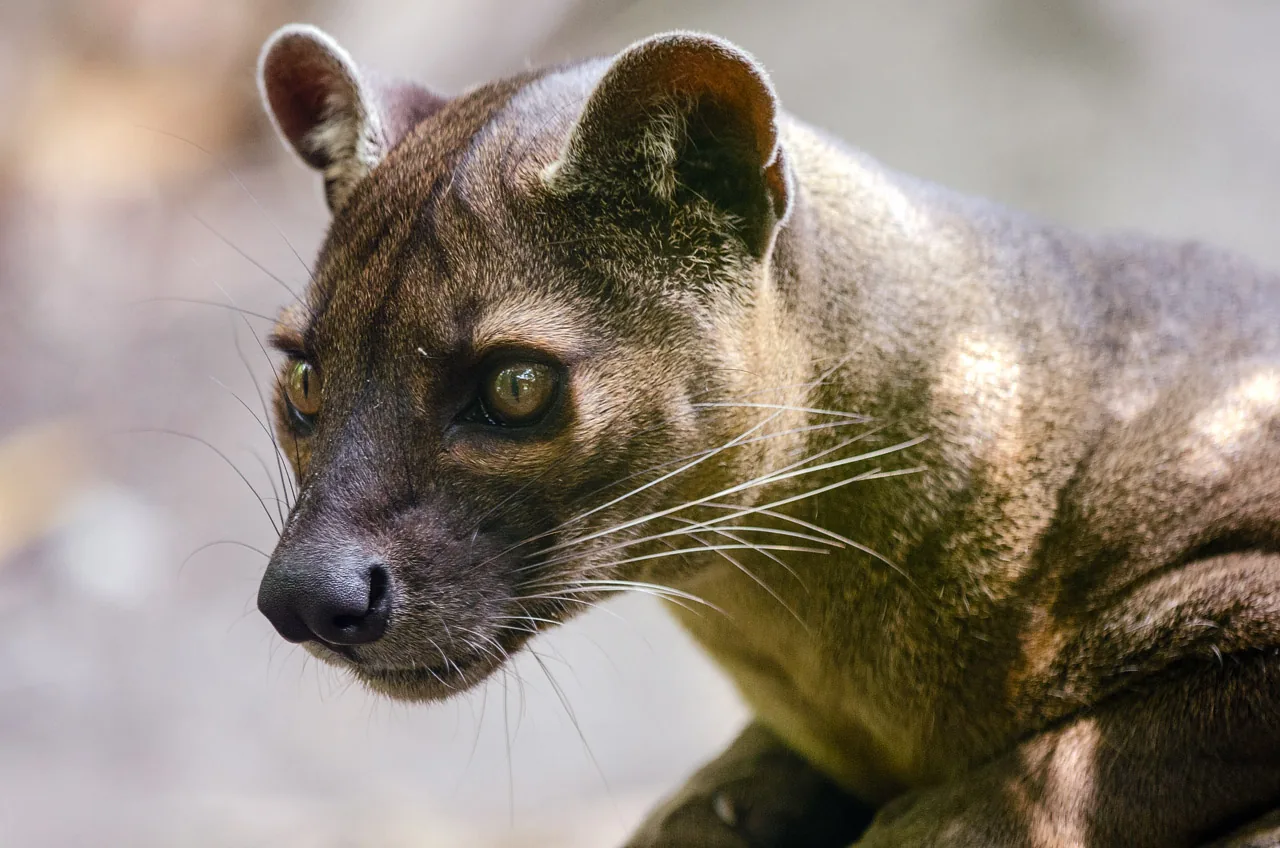
The fossa is Madagascar's largest living native carnivore and an important predator in forest food webs. It is not a cat, despite its catlike outline; it belongs to the Malagasy carnivore family Eupleridae. Arboreal movement, flexible hunting behaviour, and a broad diet make it difficult to understand through brief sightings alone.
Forest loss and fragmentation affect both the fossa and the native prey communities on which it depends. Camera traps and field signs can help researchers document distribution, but effort must be consistent before results are compared. Conservation writing should avoid invented reserve reports or claims of a local recovery unless those sources are named and dated.
A carnivore found only on Madagascar
The fossa is Madagascar's largest native carnivorous mammal and belongs to a distinctive group of Malagasy carnivorans. It is often described as cat-like, but that comparison is about appearance and behavior rather than close taxonomic identity. The fossa moves through forest with a flexible body and can climb, hunt on the ground, and use trees. Its diet includes lemurs and other small vertebrates, although what it takes depends on the habitat and prey available. Describing it simply as an apex predator can obscure the ecology of a small island where predators and prey have evolved together.
Forest structure creates hunting opportunities
A fossa's ability to travel between canopy and ground means that the condition of a forest is more than a question of tree cover. Large connected areas can provide routes, resting places, and access to prey, while fragmented forest may force animals across exposed or human-dominated land. Different kinds of forest can support different prey communities, so a single habitat label should not be treated as a complete ecological description. Studies that combine camera traps, direct signs, and local ecological knowledge can help map where fossas occur and how they use landscapes. Those methods should be reported clearly because elusive animals are easy to under-detect.
Predation does not make prey disposable
The fossa's relationship with lemurs can capture attention, but a predator-prey story is not a simple contest between a villain and a victim. Predation is part of ecosystem function, and its effects depend on prey behavior, habitat, and the availability of alternatives. A single observed hunt cannot describe the diet or population impact of a predator. Researchers may use scat analysis, camera records, and behavioral observations to understand feeding while recognizing that each method has limits. If a report claims that fossas are reducing a particular lemur population, it should cite evidence that measures both predator activity and prey trend over time.
Fragmentation affects more than the animals
Forest loss can isolate wildlife, but it also changes local livelihoods, access to resources, and the way conservation decisions are made. A fossa may move through a patchwork of protected forest, agricultural land, and community-managed areas. Protecting one reserve is valuable, yet the animal's movement can depend on what happens beyond the boundary. Conservation planning can identify key links between forest blocks and work with landholders to retain vegetation or reduce conflict. Recommendations need to fit local priorities and laws; outsiders should not assume that a particular land-use choice is simple or cost-free for residents.
What camera records can establish
A camera-trap photograph can verify that a fossa passed a particular location at a particular time. Repeated records may reveal patterns of activity, relative detection, or presence across habitat types. They do not automatically tell us how many fossas live in the region. Density estimates require a designed study, sufficient detections, and an analytical method appropriate to a species that may not have easily identifiable markings. Camera placement can also favor trails and underrepresent animals using other routes. A robust report makes effort visible and treats non-detections cautiously, especially when equipment was not active for the same period at every site.
Conservation priorities need local data
Because the fossa is endemic to Madagascar, its future is tied to the island's forest stewardship and biodiversity policy. Threat assessment should be grounded in current species evaluations and local studies rather than a generalized statement that all forests are disappearing at the same rate. Researchers can ask which forest blocks support stable occupancy, where animals cross degraded land, and whether human-wildlife encounters are increasing. The Small Carnivore Specialist Group and national institutions can help direct readers to current expertise. A conservation article should make clear when it is describing a broad pattern and when it is discussing a documented local result.
A better way to tell the story
The fossa is compelling because its ecology challenges familiar categories: it is not a domestic cat, and its role cannot be explained by a single food-chain diagram. A useful species profile connects anatomy, movement, prey, and habitat, then shows how researchers distinguish observation from population inference. It also avoids claiming that a species is thriving or collapsing without a dated assessment. Readers can support conservation by valuing Madagascar's forests and the people who steward them, but the article should not turn that general sentiment into a promise of measurable impact. Specific, verifiable questions make a stronger foundation for action.