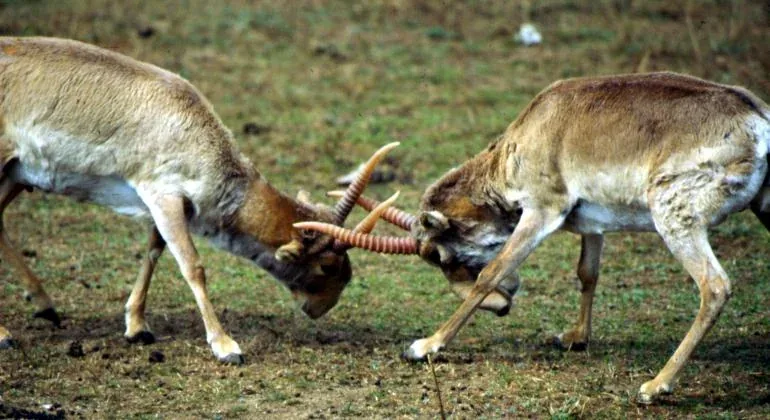
Saiga antelope are adapted to open steppe and semi-desert systems and undertake seasonal movements across large areas. Their distinctive enlarged nose is associated with filtering dust and conditioning air, but the species' best-known conservation lesson is how quickly a population can be affected by disease, poaching, and disrupted movement routes.
The saiga's status has changed as conservation responses and population trends have changed, so older reports can be misleading. Always state the assessment year when using a category or estimate. International coordination matters because herds cross borders; protected areas alone cannot conserve a migratory animal if routes, seasonal ranges, and enforcement remain disconnected.
A nose adapted to an open, changing steppe
The saiga antelope's distinctive swollen nose is not just an identifying feature. The nasal structure is thought to help condition inhaled air in dusty summers and cold winters, an adaptation to the exposed Eurasian steppe. Saigas feed on vegetation that changes with rainfall and season, and their movements reflect the shifting availability of green forage. The open landscape can make large herds visible, yet visibility is not equivalent to a precise census. A good account explains the conditions under which animals move and the methods used to count them, rather than presenting the steppe as a static background.
Migration follows forage and weather
The Convention on Migratory Species describes saiga movements as a mix of wide-ranging nomadism and more directed seasonal migration. Local precipitation can trigger vegetation growth, so herds may shift routes to follow forage. In some populations, journeys between winter and summer ranges extend for hundreds of kilometres. These routes are not necessarily identical every year: weather, snow depth, barriers, and land use can alter where animals travel. Protecting only a calving site may therefore miss the paths that connect it to feeding and wintering areas. Monitoring should map movement over time and include the habitats animals use between familiar landmarks.
Calving synchrony brings both opportunity and risk
Saiga females often gather to give birth during a short seasonal window, creating dense calving aggregations. Such concentrations may help young animals benefit from a large group, but they can also create conditions in which disease spreads rapidly. The severe mass mortality recorded in Kazakhstan in 2015 demonstrated how a single event can affect a population at scale, yet it should not be used to imply that every die-off has the same cause. Veterinary investigation, weather records, and field observations are needed to understand an event. The lesson is to maintain surveillance before a crisis and report uncertainty while investigations continue.
Infrastructure can divide a migration
Fences, roads, railways, and other linear infrastructure can make it harder for a migratory herd to reach seasonal habitat. The effect depends on the location and design of a barrier, as well as the behavior of the animals and the condition of nearby crossing options. A structure that appears small on a national map may intersect a narrow movement route. CMS publications on migration and infrastructure provide a framework for thinking about these risks. Field tracking and repeated surveys can show whether a route is still used after construction, and whether practical crossing measures are helping.
A population can rebound and remain vulnerable
Saiga numbers have changed dramatically over recent decades, and recovery in some populations has been an important conservation development. At the same time, the species remains exposed to poaching, disease, habitat fragmentation, and unpredictable environmental conditions. A recent count for one herd should not be generalized to the entire range. Any numerical claim needs a population name, survey year, and method. Conservation categories and government surveys are updated periodically, so readers should check the date of the source before repeating a status or total. The story is not a straight line from decline to safety; it is a changing balance of risk and response.
International agreements coordinate shared responsibility
The CMS Saiga Memorandum of Understanding is a non-binding international instrument that brings range states together around monitoring, distribution, migration, poaching, and trade. Its purpose is practical: a migratory animal cannot be conserved by a single jurisdiction if it crosses borders during the year. The agreement does not by itself guarantee implementation, funding, or enforcement. Its value depends on national plans, local capacity, community participation, and data that can be compared across countries. Readers can evaluate progress by looking for published work programmes and reports rather than assuming that the existence of a treaty means the objectives have already been achieved.
Steppe conservation needs people and animals
The steppe is a working landscape for people as well as wildlife. Pastoral livelihoods, transport routes, protected areas, and seasonal use all influence conservation options. Measures to reduce poaching or keep migration routes open are more durable when local communities help design them and share in the benefits. CMS guidance includes community participation as part of the wider conservation picture. A respectful report should describe these social conditions without romanticising the steppe or casting residents as obstacles. Long-term saiga conservation requires both ecological evidence and institutions that can work across borders and alongside people who live in the range.