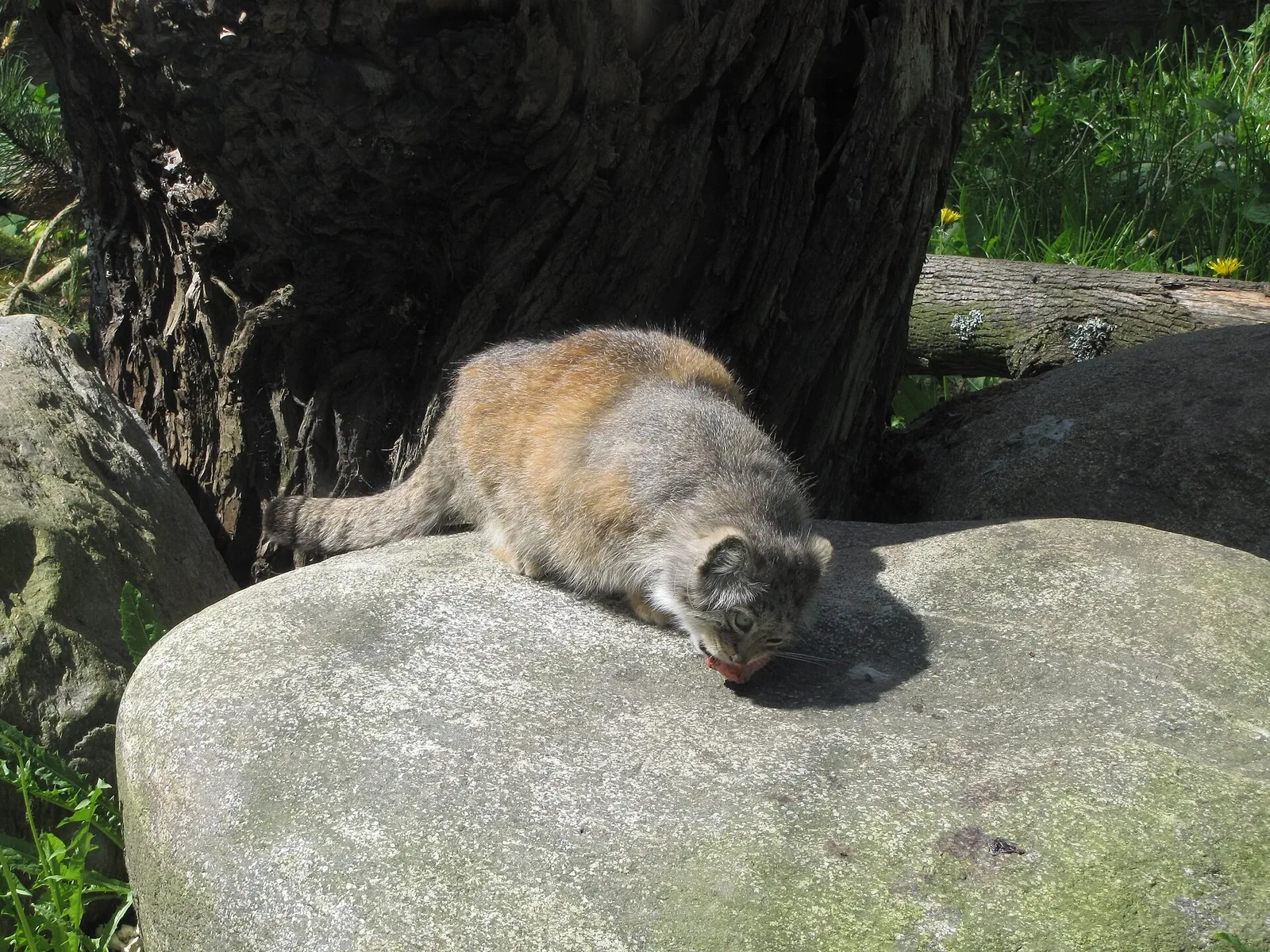
Pallas's cats inhabit open, often cold and rocky parts of Central Asia. Their dense coat and low profile provide camouflage against a steppe background, while rocky crevices can offer shelter. These adaptations do not make the species immune to disturbance: habitat conversion, prey availability, and infrastructure can alter the places it can use.
Because the cat is elusive, camera traps and sign surveys are important tools, but survey effort must be reported to interpret detection rates. The species account linked here summarises current specialist knowledge. Avoid reproducing precise den locations or treating isolated photographs as evidence of a population trend.
A small cat in a large, open landscape
Pallas's cat, also called the manul, inhabits the steppe and rocky uplands of Central Asia. Its dense coat and flattened appearance help it blend into cold, arid landscapes, but camouflage is only one part of its ecology. The cat uses rock crevices and the abandoned burrows of other animals for shelter and denning. The IUCN Cat Specialist Group describes habitat specialization and fragmentation as important concerns. A species profile should explain this reliance on shelter and prey rather than presenting the cat only as a photogenic face in the grass.
Burrows can be as important as prey
Pallas's cats use cavities such as marmot burrows and rock spaces to hide from predators, rest, and raise young. They are not well equipped to excavate their own burrows, so the availability of existing shelter can shape where they persist. Changes to marmot populations, livestock use, and disturbance can therefore affect a resource that is easy to overlook in a broad habitat map. A study that records only vegetation cover may miss this structural feature. Researchers can document shelter availability and its relationship to camera detections while taking care not to expose active dens publicly.
Camouflage creates a detection problem
The manul often remains still when threatened, relying on its coat and terrain rather than running across open ground. This behavior makes the species challenging to survey and can bias observations toward trails or camera locations where a cat happens to pass. Repeated camera-trap surveys, snow tracking, and telemetry can contribute different evidence. A handful of photographs cannot establish a stable population. Survey design should account for the cat's low density, movement, and the patchy distribution of suitable habitat. The Cat Specialist Group notes that declines may be difficult to detect precisely because so little is known in many regions.
Steppe habitat is a complex patchwork
Pallas's cats use grassland, shrub-steppe, rocky slopes, ravines, and semi-desert settings, often where cover and prey are available. Overgrazing, mining, roads, and other infrastructure can alter the patchwork and increase disturbance. The effect depends on local prey, snow conditions, and how much alternative habitat remains. A broad range map can make the cat seem widespread while suitable habitat is fragmented within that range. Conservation planning needs finer-scale information about shelter, prey, and movement. Protecting only a scenic reserve may miss the connecting land that makes a viable area possible.
Prey control can have unintended effects
Pikas and other small mammals are prey for Pallas's cats, but in some regions they may be poisoned or controlled for reasons unrelated to wildlife conservation. Such actions can reduce food availability and affect other species. Evaluating a prey-management campaign requires evidence about target species, methods, and ecosystem effects. A simple claim that prey abundance is falling should identify the species and monitoring period. Conservation teams can work with livestock producers and authorities to assess alternatives, but recommendations should be grounded in local conditions rather than generalized across all Central Asian grasslands.
Climate projections need careful language
The IUCN Cat Specialist Group discusses potential climate-related changes such as warmer, more humid conditions, altered snowfall, fire, and vegetation shifts. These are risks to investigate, not exact forecasts for every location. More snow may affect movement and access to prey, while vegetation change can alter the open habitat the species uses. Long-term weather and habitat monitoring can help test which mechanisms are occurring. A responsible article distinguishes projected threats from observed changes and names the region or model used. The manul's future depends on several interacting pressures, not one climate variable alone.
Conservation needs better local records
Pallas's cats occur across multiple countries, and legal protection differs among them. A global status label does not show whether a local population is secure or whether laws are enforced. Camera surveys, prey monitoring, mortality records, and community reporting can fill important gaps. Protected areas may help, but large home ranges can extend beyond boundaries. The Cat Specialist Group calls for better distribution surveys and monitoring. Public accounts can contribute by presenting dated evidence, not by repeating old population estimates as if they were current. Protecting the cat means preserving the quiet, connected features of a steppe landscape.
The IUCN assessment provides a global evaluation, while the specialist group account explains natural history and current research context. Together they support a more careful summary than a bare status label. Both sources may be updated, so readers should record when they consulted them.