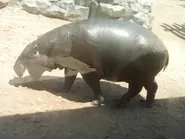
The pygmy hippopotamus is a forest-associated relative of the common hippopotamus, with a much smaller range in West Africa. It is elusive and largely nocturnal, so reliable population knowledge comes from field signs, camera traps, and carefully designed surveys rather than casual sightings. Forest streams and swampy areas are part of its habitat, not simply a backdrop.
Logging, agriculture, mining, and human settlement can fragment the lowland forest landscapes it needs. Because survey conditions are difficult, precise population totals should be attributed to a dated assessment and not repeated as timeless facts. Conservation planning needs to connect protected forest blocks with local land stewardship and reduce disturbance in sensitive areas.
A forest mammal, not a smaller river hippo
The pygmy hippopotamus is a separate species from the much larger common hippopotamus. It lives in the forests of West Africa, with Liberia at the centre of its range and smaller range areas in neighbouring countries. Although it is associated with water, the Hippo Specialist Group notes that pygmy hippos spend more time on land than common hippos do. They travel through dense vegetation on recurring paths and use water for cooling and other needs. This combination helps explain why the species can be difficult to find: a river survey alone may miss much of the habitat it uses.
Forest paths leave clues
Pygmy hippos may use tunnel-like tracks through thick undergrowth, and they can mark areas with dung. Such signs can help researchers understand where an animal moves without requiring constant direct observation. But signs are not a census. A trail might be used by more than one individual, and a location with no visible sign may still be visited at another season. Camera traps, track surveys, interviews with trained local observers, and habitat mapping can be combined to build a clearer picture. Each method should include dates and effort so that a future survey can distinguish a real change from a change in detection.
A species threatened by a changing forest
The main pressures described by the specialist group include habitat loss associated with logging, settlement, and agricultural clearing. The scale and effect of those pressures differ among sites, so a statement about one forest should not be generalized to the entire range. Fragmentation can isolate animals from suitable habitat and may make movement riskier, especially where roads and human activity divide patches. Conservation planning therefore needs to map both known occurrences and the condition of connecting forest. Protecting a boundary on paper is not enough if the habitat inside is degraded or if animals cannot safely move to nearby patches.
Why local knowledge belongs in the record
People who live near pygmy hippo habitat may hold valuable information about tracks, encounters, seasonal movement, and changes in land use. Research can only use that knowledge responsibly when participation is voluntary, credit and data control are discussed, and sensitive locations are protected. Community reports are not a substitute for ecological surveys, but neither should they be dismissed as informal. A study can combine locally collected observations with camera detections and remote-sensing data, then explain how records were verified. This approach recognizes that long-term conservation depends on people who live with the species, not solely on visiting research teams.
Managed care has a supporting role
Zoos and conservation institutions maintain regional breeding programmes and an international studbook for pygmy hippos. Those records can support population management under human care and improve knowledge about health and reproduction. They do not directly show that wild habitat is secure. A captive population and a wild population face different pressures and require separate indicators. Any proposal to release animals would need careful consideration of health, origin, local habitat capacity, and long-term monitoring. Public communications should state clearly whether an announcement concerns a birth in managed care, a field survey, or a change in the species' wild status.
The value of cross-border planning
The species' range includes forest areas near national borders, which makes cooperation between neighbouring countries important. Shared methods can help agencies compare habitat change and coordinate research, while common safeguards reduce the chance that sensitive locations are disclosed. The regional strategy described by the Hippo Specialist Group highlights connectivity and research as linked priorities. That is a reminder that conservation does not stop at a reserve fence or a national boundary. Plans should identify who will maintain monitoring, how communities will participate, and what evidence will trigger a change in management.
How to describe an elusive species honestly
The pygmy hippo is charismatic, but many details of its wild ecology remain difficult to measure. A strong species profile can be informative without filling every gap with confident-sounding estimates. It should name the source and date for range and threat information, distinguish observed behavior from broader inference, and avoid presenting zoo knowledge as a picture of wild populations. For readers, the most useful takeaway is that forest continuity, quiet movement routes, and local monitoring all matter. The species is best understood through patient evidence gathered over time, with the limitations of each method made visible.
Signs such as tracks, dung, feeding evidence, and camera-trap records can guide survey teams, but they can be difficult to interpret in dense forest. Survey design should be adapted to the terrain and season, with uncertainty reported rather than converted into an unsupported exact count.