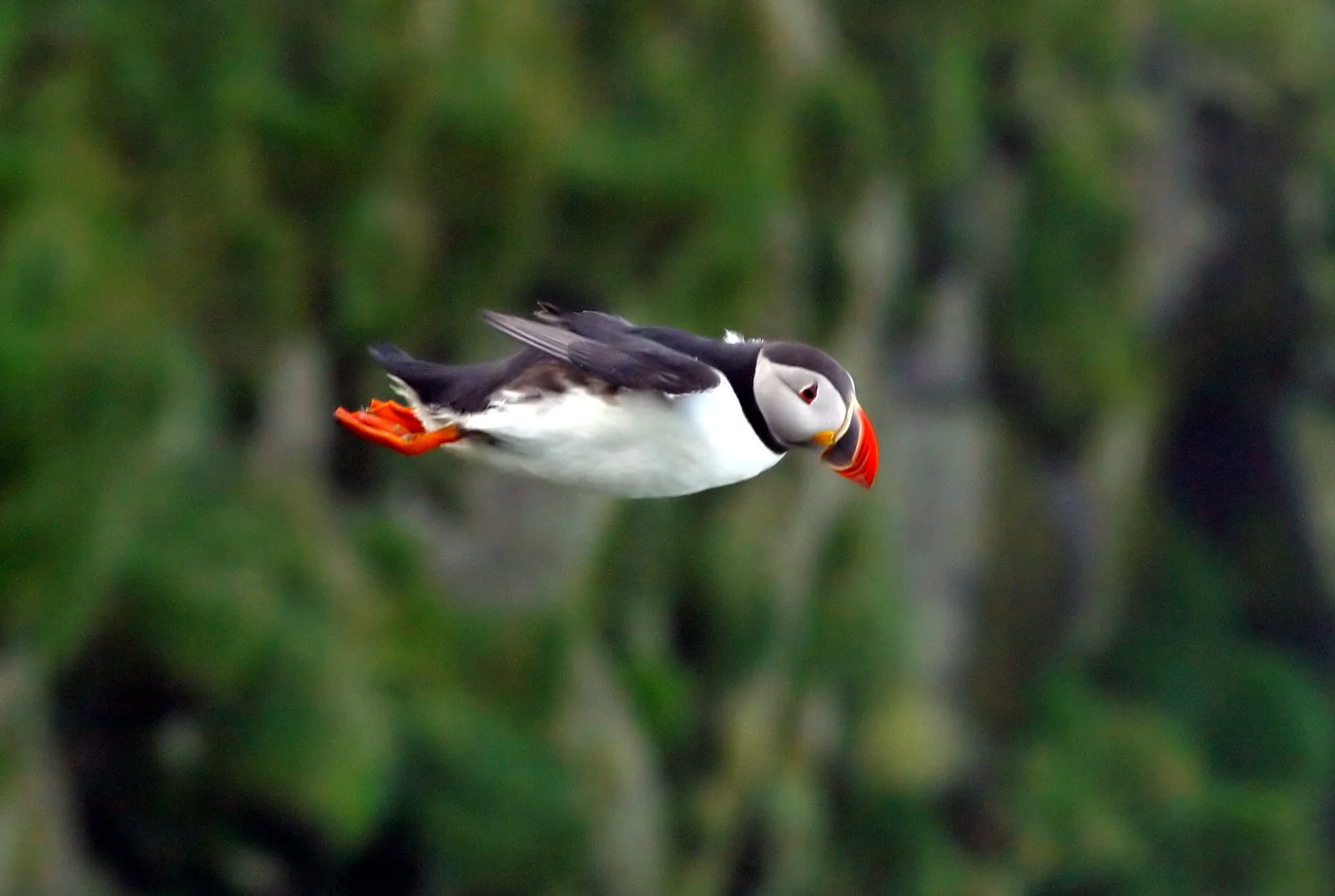
Atlantic puffins depend on marine food webs as well as safe nesting sites on islands and sea cliffs. Breeding adults make repeated trips to provision chicks, so changes in forage fish availability can affect reproductive success. The relevant prey species and pressures differ among colonies; one site's poor season should not be used to describe every population.
Colony monitoring may include burrow occupancy, adult attendance, chick growth, and diet data, collected under protocols that limit disturbance. Climate and fisheries can affect prey distribution, while invasive predators can threaten nesting sites. Use current regional seabird assessments for status and trend, and respect seasonal access closures around colonies.
A colony is a place and a seasonal event
Atlantic puffins return to coastal breeding sites to nest in burrows or crevices and raise a single chick. A cliff colony can appear crowded from a distance, but the number of birds visible at sea or on the ledges does not equal the number of breeding pairs. Some individuals are foraging, prospecting, or resting elsewhere. Monitoring needs a defined unit—occupied burrows, adult attendance, breeding success, or offshore distribution—and a method suitable for that question. RSPB species resources explain puffin ecology and conservation context; local colony surveys are necessary for year-specific outcomes.
Food links offshore conditions to the nest
Adult puffins forage at sea and bring fish back to their chicks. The availability, size, and distribution of prey can influence how far adults travel and how often they feed young. Ocean temperature and currents may affect prey communities, but a colony's breeding success can also be shaped by weather, predation, disturbance, and adult condition. Researchers therefore combine nest monitoring with marine surveys or tracking data where possible. A poor breeding season does not by itself establish a long-term decline, and a successful year does not prove that underlying pressures have disappeared.
Burrow counts have practical limits
Puffins often nest underground, making direct observation difficult. Researchers may use burrow occupancy checks, camera probes under permits, or adult activity at entrances. Each method can disturb nesting birds if used too often or at the wrong stage. Plots and sample designs help estimate a colony while reducing the need to inspect every burrow. Results should note the timing and number of visits. If burrows are blocked by vegetation or erosion, apparent occupancy can change without the birds themselves changing. A clear protocol is essential for comparing years and colonies.
Sea cliffs are exposed to more than weather
Breeding colonies face storms, erosion, human disturbance, invasive predators on islands, and changes in prey availability. The importance of each pressure differs by site. Climate trends may alter marine food webs and storm exposure, but direct attribution requires evidence. A local report should specify what was measured and avoid treating the whole North Atlantic as one uniform environment. Coastal development and tourism can also affect access and disturbance. Management may include seasonal closures or visitor routes, but these decisions should be based on colony sensitivity and local rules rather than a single global recommendation.
Observing puffins without changing their behavior
Visitors should watch from designated viewpoints, keep to marked paths, and avoid approaching burrow entrances. A long lens or binoculars can show detail without entering a nesting area. Dogs and drones may be prohibited or particularly disruptive at colonies. If birds repeatedly alarm, leave, or stop feeding, the observation is too intrusive. The exact rules vary by reserve and country, so check local guidance before visiting. Wildlife tourism can help people value seabirds, but photographs should not be made at the cost of the breeding behavior that makes the colony worth protecting.
Climate risk requires long records
A warming ocean can shift the timing or location of prey, but seabird responses are not identical across colonies. Long-term breeding and at-sea data are needed to connect ocean conditions with chick survival or adult movement. Researchers can compare temperature, prey, adult trip duration, and breeding outcomes over time. Short observations may catch a particularly good or poor season. News accounts should use dates and avoid saying that one breeding failure was caused by climate change unless the study supports that attribution. The uncertainty is part of the science, not a reason to ignore a plausible risk.
What recovery would mean
Puffin recovery would be reflected in stable or improving breeding indicators, healthy prey access, and colonies that remain resilient across variable years. A change in one indicator should be interpreted alongside population trend and habitat condition. RSPB and local wildlife agencies publish updates, but the year and survey method matter. Conservation can include protecting nesting sites, reducing invasive-predator impacts where appropriate, and managing fisheries and marine habitats. The most honest story recognizes both the species' familiar charm and the less visible ecological relationships that determine whether a chick can be raised successfully.
Puffin monitoring often tracks breeding success and adult attendance over repeated seasons. Diet samples and prey surveys can help test whether food availability explains chick outcomes. Because colonies differ in location and ocean conditions, combining local data with broad seabird assessments gives a more balanced picture.