Kelp forests are built by large brown algae in cool, relatively shallow coastal water. Their vertical structure provides food and shelter for many fish, invertebrates, and marine mammals. Like land forests, kelp communities change seasonally; storms and warm-water events can remove canopy, and regrowth depends on local conditions and grazing pressure.
Monitoring a kelp forest requires more than recording whether kelp is present. Canopy extent, species composition, temperature, herbivores, and disturbance history help explain why one site recovers and another does not. NOAA's overview describes the ecology of kelp forests, while local marine managers can provide site-specific access and protection rules.
A kelp forest is built by large brown algae
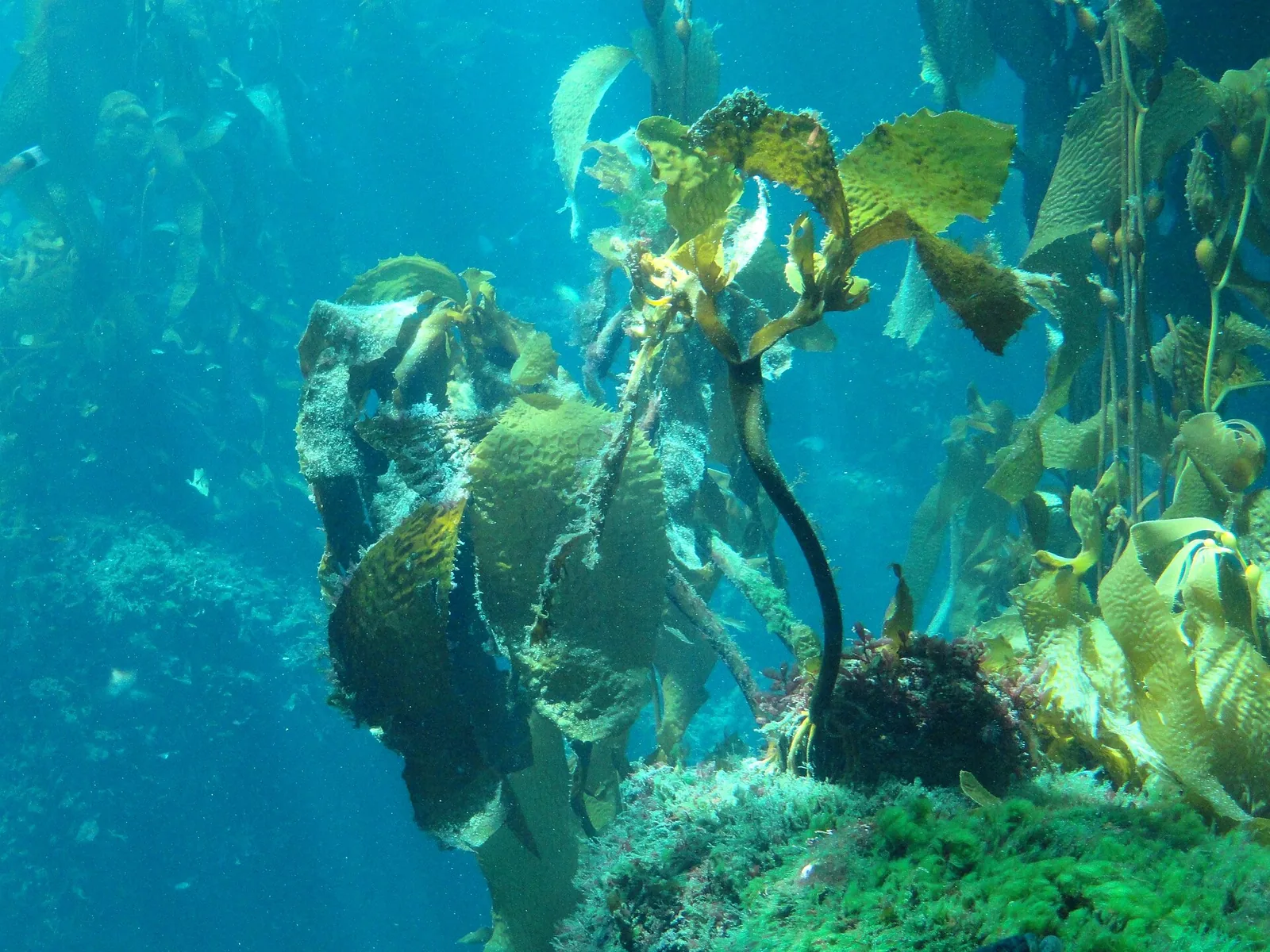
Kelp are large brown algae that attach to rocky surfaces and grow in cool, nutrient-rich coastal waters. Their upright blades and holdfasts create three-dimensional habitat that can shelter fish and invertebrates. NOAA explains that kelp forests support coastal food webs and are influenced by light, nutrients, temperature, and water movement. The forest is not a collection of underwater trees: kelp are algae, and their growth and life cycle differ from terrestrial plants. This distinction helps readers understand why monitoring water conditions and rocky substrate is central to interpreting changes in kelp cover.
Structure creates habitat at several heights
A kelp forest includes more than the canopy visible near the surface. Blades, stipes, holdfasts, and the spaces between them offer different microhabitats. Small invertebrates may use the structure, while fish and marine mammals may feed or shelter nearby. When canopy cover thins, the change can alter light and habitat conditions below it. The effects depend on which species of kelp are present and how the local community responds. A map showing area alone may miss differences in density, species composition, or the condition of the understory, so field surveys can complement aerial or satellite imagery.
Temperature and nutrients set boundaries
Kelp growth is influenced by temperature, light, nutrients, waves, and grazing. Marine heatwaves can stress kelp and shift the conditions under which forests persist, but a regional heat event does not produce identical outcomes at every site. Upwelling, depth, currents, and species traits all matter. A good report names the location and time period, then distinguishes observed loss from a forecast. Long-term records help reveal whether a decline is part of natural fluctuation or a persistent change. NOAA's general overview is a starting point; site-specific monitoring is needed before attributing a local forest change to one driver.
Urchins can change the shape of a forest
In some kelp systems, sea urchins graze heavily when predator populations or environmental conditions change, and dense grazing can leave rocky areas with little kelp. These so-called urchin barrens are not a universal outcome, and the interaction between predators, urchins, and kelp differs by coast. Restoration projects may remove urchins or reintroduce ecological processes, but an intervention should be supported by local evidence. Monitoring needs to track more than the return of visible kelp: it can also measure species composition, grazer abundance, habitat structure, and whether the forest persists through warm periods.
Restoration is a question of conditions
Planting or seeding kelp can be useful in some locations, yet restoration is unlikely to persist if the original pressure remains. Managers may need to address water quality, grazing, fishing impacts, or physical disturbance before re-establishment can succeed. Some projects use natural recovery and protect source populations; others test outplanting techniques. The choice should follow a diagnosis, not a one-size-fits-all recipe. Researchers can compare treated sites with reference locations and publish failures as well as gains. A few new blades in a pilot plot do not demonstrate that a functioning kelp forest has returned.
Coastal communities are part of the ecosystem
Kelp forests support fisheries, recreation, and cultural practices, so changes affect people as well as marine life. Management decisions may involve fishers, Indigenous communities, scientists, and coastal agencies. Their knowledge can help identify seasonal changes and practical constraints, while scientific monitoring adds repeatable measures. Participation should not be treated as a box to tick after a plan is already fixed. Projects are stronger when communities help define the questions and have access to the results. Conservation communication should also avoid promising that a kelp intervention will automatically improve fisheries without evidence from that specific site.
What a useful kelp report includes
A reader should be able to tell which coast and kelp species were studied, how canopy or habitat condition was measured, and over what period. Reports can state survey effort, temperature or nutrient records, and the uncertainty around mapped area. They should identify whether a forest was observed directly or inferred from remote sensing. NOAA's kelp resource offers basic ecological context, while sanctuary and local monitoring programmes provide place-specific information. The central point is that kelp is both habitat and a response to changing ocean conditions. Understanding its future requires repeated local observations linked to the larger marine environment.
Kelp abundance can be shaped by grazing, storms, marine heatwaves, nutrient conditions, and the availability of hard substrate. The relative importance of these drivers differs by coast. A dense canopy at one site does not reveal whether a nearby forest is recovering or whether the community beneath it has changed.