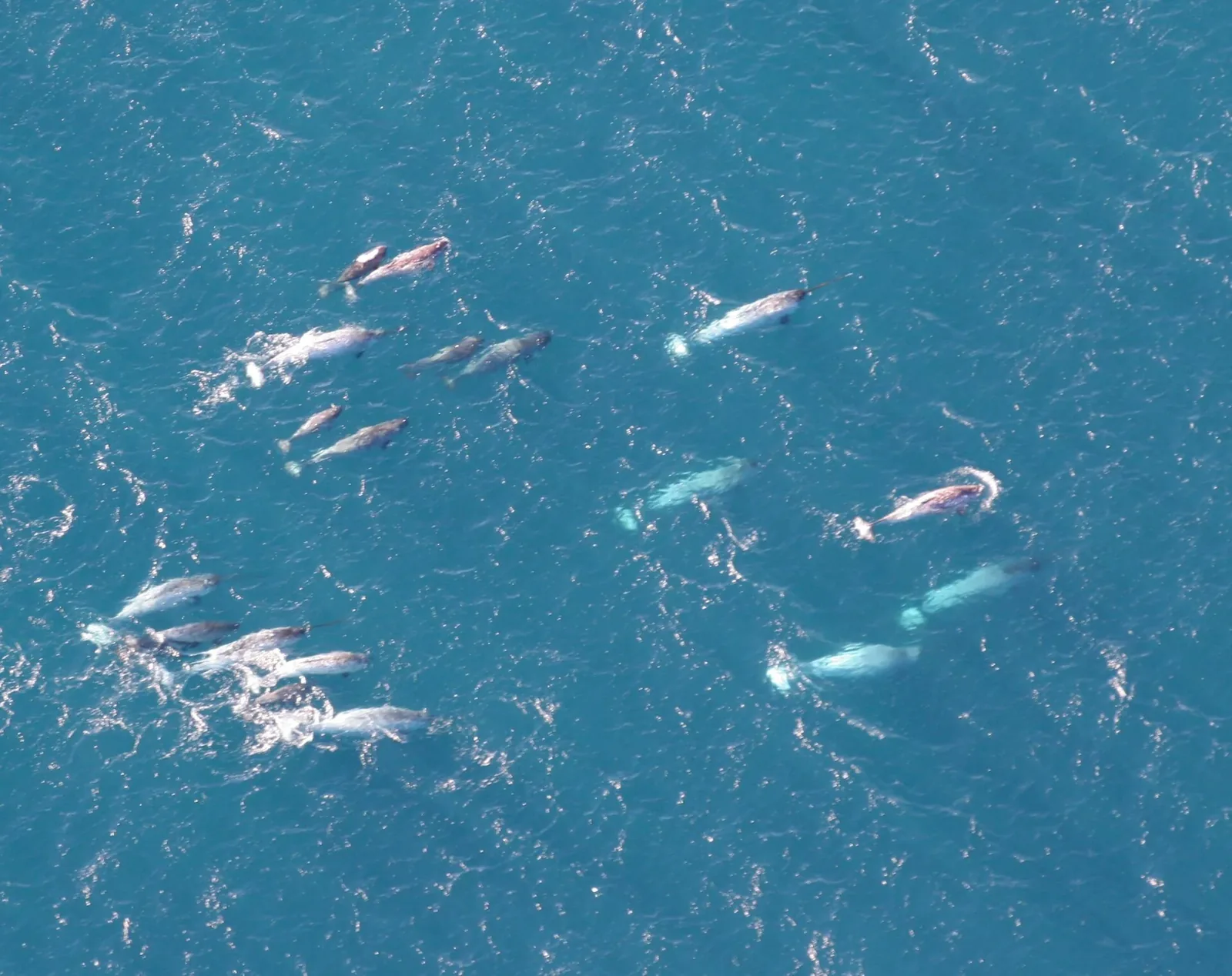
Narwhals are Arctic whales whose movements are shaped by sea ice, prey, and seasonal open-water conditions. Their clicks, whistles, and pulsed calls are part of a soundscape that researchers can study with hydrophones. More open water can alter shipping and noise exposure, but the effect on a population cannot be inferred from a single acoustic recording.
Long-term research combines satellite tracking, acoustic monitoring, harvest information, and community knowledge. Narwhals are divided into management populations, so a regional result should not be generalised to the entire species. The linked Arctic research programme provides context for monitoring; consult current management authorities for local conservation and harvest rules.
A whale's soundscape is part of its habitat
Narwhals live in Arctic waters where sea ice, depth, prey, and seasonal movement shape the environments they use. They produce clicks, whistles, and other sounds that researchers can study with underwater microphones. Hydrophones can record animals when visual surveys are difficult, but a sound file is not a head count. Different calls can overlap, travel different distances, or be masked by noise. Researchers need to describe their equipment, recording season, and classification method. The useful question is often how the acoustic environment changes and which animals are present, rather than whether one recording proves a population trend.
Sea ice and open water create changing routes
Narwhal movements are linked to seasonal sea-ice conditions and access to open water. Changes in ice timing can alter when and where animals travel, while shipping and industrial activity may introduce additional noise. These factors can interact, but their effects must be evaluated in a particular region and season. A broad statement about 'the Arctic' can hide differences among narwhal populations. Tracking data, local observations, acoustic records, and harvest monitoring each answer different questions. Reports should identify the population or management area and avoid generalizing from a single tagged whale.
Listening does not reveal everything
An acoustic detector may register calls but not identify the caller's age, condition, or exact position. Sound can travel far underwater, and propagation changes with depth, temperature, and ice. A rise in recorded calls could reflect more animals, a change in calling behavior, or different equipment and placement. Long-term studies need consistent deployment and careful calibration. Analysts can compare sound records with visual observations or satellite tags, then explain what each method contributes. Acoustic monitoring is powerful in remote seas precisely because it can operate when people cannot see animals, but that convenience should not obscure uncertainty.
Community knowledge complements instruments
Inuit and other Arctic communities hold knowledge of seasonal conditions, animal behavior, and travel routes built through repeated observation. This knowledge should be included with consent and appropriate recognition, not treated as a substitute dataset that researchers can freely extract. Instrumental records can provide standardized measurements, while community observations may detect changes over broader time periods or in places where monitoring is sparse. Ethical research clarifies data ownership and how findings will be shared. A strong account of narwhal acoustics recognizes both the technology and the people whose lives are connected to the same waters.
Noise is one pressure among several
Vessel noise, seismic activity, and other sound sources may affect how marine mammals communicate or respond, but the biological significance depends on species, intensity, duration, frequency, and context. Researchers measure exposure and behavior rather than assuming that every sound has the same effect. Ice loss can also open new routes for vessels, creating a potential interaction between habitat change and noise. NOAA's Arctic marine mammal resources provide a starting point for the broader setting, while peer-reviewed studies are needed for specific acoustic effects. The article should not convert a plausible mechanism into a proven population-level outcome without evidence.
Monitoring requires a regional design
A useful programme combines passive acoustics with seasonal visual surveys, movement tracking, and local knowledge where possible. The design should cover relevant periods and locations, include equipment calibration, and document missing data. It also needs a plan for sensitive locations and animal welfare when tags are used. Narwhal populations are managed regionally, so data from one area cannot automatically represent another. A report that names its population, season, and method helps readers evaluate the scale of its conclusion and follow the underlying research.
Keep the conservation question specific
Instead of asking whether narwhals are 'doing well,' a monitoring project might ask whether a route is used later in the season, whether vessel noise overlaps with an important habitat period, or how detection patterns change across years. Specific questions are easier to connect to decisions. Management authorities and local communities can then decide whether more monitoring, route planning, or other measures are appropriate. The narwhal's soundscape is a window into a changing Arctic, but it is not a single alarm. Careful interpretation protects both the scientific value of the record and the complexity of the animals' environment.
Narwhal acoustic studies depend on sensor placement, recording duration, and sound conditions. Ship noise may mask calls or change how researchers detect them, while ice also affects how sound travels. These are reasons to combine acoustics with other data, not proof that every change in sound indicates a population response.