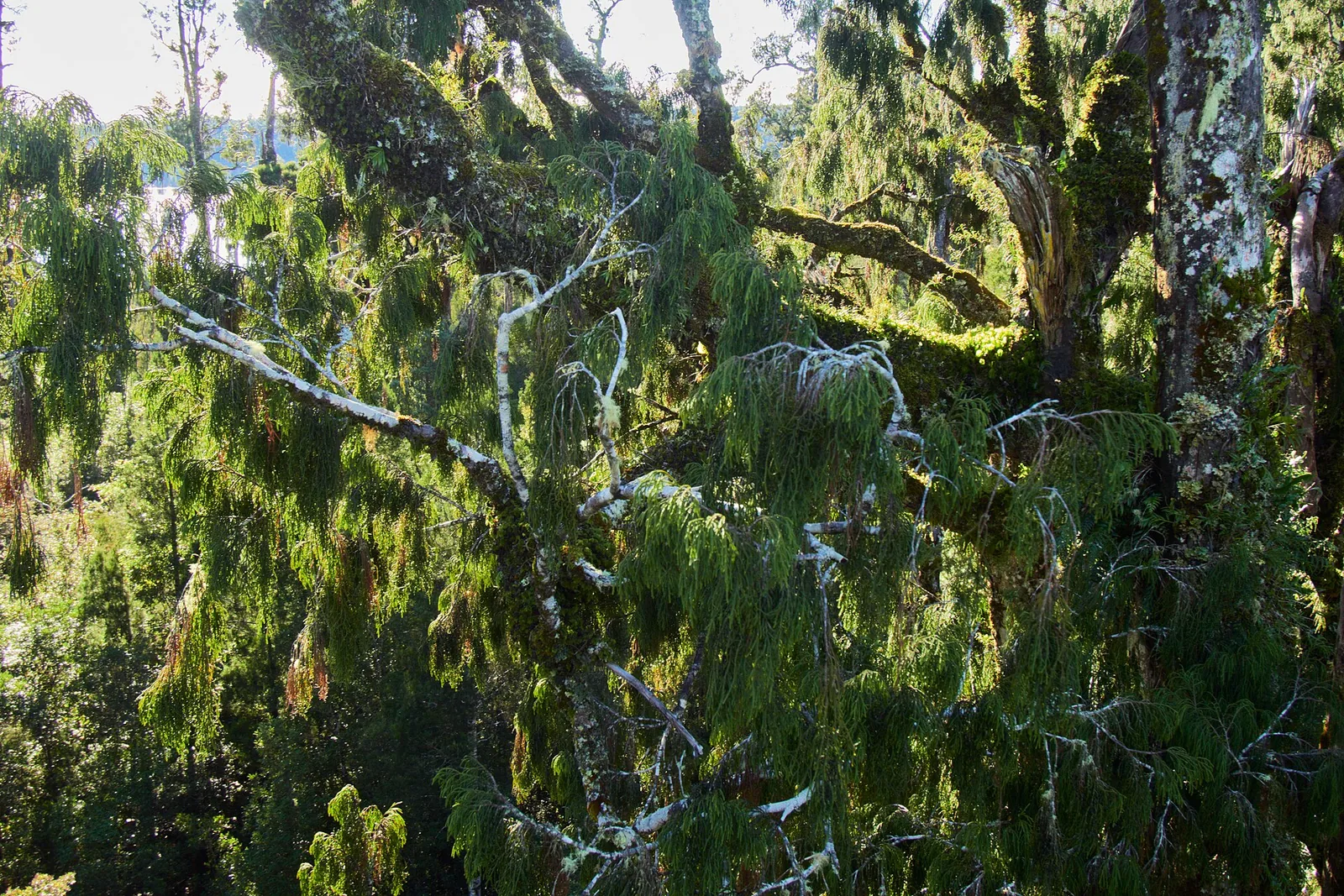
A rainforest canopy is a three-dimensional habitat, not a single layer of green. Light, moisture, and food change from emergent crowns to shaded understory, and many organisms spend most of their lives above the forest floor. A portrait can show one moment, but it cannot by itself represent the diversity or health of the whole canopy community.
Canopy research uses varied methods, including climbing systems, towers, remote sensing, and observations from the ground. Each samples different organisms and spatial scales. This gallery page is an illustrated introduction rather than a field photo archive; consult the linked biodiversity assessments for evidence about species composition and change.
The canopy is a living layer, not a distant ceiling
The rainforest canopy includes branches, leaves, flowers, fruit, vines, epiphytes, and the animals that use them. It is also where much of a forest's exchange with the atmosphere takes place. From the ground, observers see only fragments, which is one reason the Smithsonian Tropical Research Institute developed canopy access methods such as research cranes in Panama. Canopy work has revealed interactions that were difficult to study from below. The forest is not vertically uniform: conditions change with height, gaps, tree species, and time of day, creating many small habitats within one broad canopy.
A vertical landscape changes with light
Sunlight, humidity, wind, and temperature vary between the forest floor and upper canopy. A sunlit crown may support different leaves and visitors from a shaded understory. Lianas connect trees and can form travel routes, while epiphytes use branches as a platform without rooting in soil. These layers affect where animals forage and where plants flower or set fruit. A study should state the height and sampling method because a ground transect cannot automatically represent life above it. Canopy access cranes, climbing systems, and remote sensing each offer different views and have different safety and sampling constraints.
Fruit and flowering create moving resources
Trees do not produce flowers and fruit all at once. Their timing can vary by species, rainfall, and climate conditions, creating pulses of food that attract insects, birds, and mammals. When fruiting shifts, animals may change routes or spend more time in particular crowns. A single visit may miss these cycles. Long-term monitoring helps researchers connect plant phenology with animal activity and weather. Smithsonian canopy research describes how climate variables shape flowering, fruiting, and photosynthesis. That work provides a reason to think of the canopy as a dynamic system, not merely a collection of species photographed at one moment.
Small interactions scale into ecosystem patterns
Pollination, seed dispersal, leaf browsing, predation, and decomposition connect canopy organisms to the forest's wider function. An ant moving along a liana or a monkey feeding in a crown may seem like a small event, but repeated interactions can influence plant reproduction and resource distribution. Researchers need to be careful when moving from an observed behavior to a forest-wide conclusion. Detailed observations can identify a mechanism; broader sampling is needed to establish how common it is. Good natural history combines precise notes about what happened with humility about what a limited sample can represent.
Studying the canopy without overselling access
Canopy cranes allow repeated access to trees in a small radius, which is valuable for detailed observation but does not sample every forest type. Researchers may pair direct canopy work with camera traps, acoustic sensors, ground surveys, and satellite data. Each method has a different detection bias. Cameras can miss animals that do not pass in front of them, while sensors may register sounds without revealing which individual produced them. A strong study explains the sampled area and the limits of the equipment. A striking canopy photograph is useful illustration, but it is not a substitute for a documented survey.
Disturbance and fragmentation reach upward
Forest edges, logging, and roads affect canopy structure as well as the ground below. Opening a gap can change light and wind exposure; isolated trees may become harder for some animals to reach. The impact depends on the species and landscape. Restoration that reconnects patches can help, but planting young trees does not instantly recreate the structure of a mature canopy. Monitoring needs a long horizon and indicators such as tree survival, canopy closure, and animal use. Reports should separate a planted area from a recovered ecosystem, because structural and biological complexity take time to develop.
A more complete forest portrait
A rainforest portrait can follow one question through several heights: how fruit availability changes movement, how canopy gaps affect microclimate, or how animals carry seeds between trees. The Smithsonian Tropical Research Institute's canopy programme offers a concrete example of research designed to reach a difficult layer of the forest. The broader lesson is methodological: describe how the observation was made and what scale it covers. A canopy is not a decorative backdrop for wildlife photography. It is a complex habitat whose interactions become clearer when researchers combine patient field observation with measurements that can be repeated.
A useful canopy study defines which layer is being sampled and how researchers reached it. Traps, visual surveys, acoustic recordings, and foliage samples each detect different organisms. Combining methods can reduce blind spots, while repeating surveys across seasons helps separate true change from short-term differences in weather or flowering.