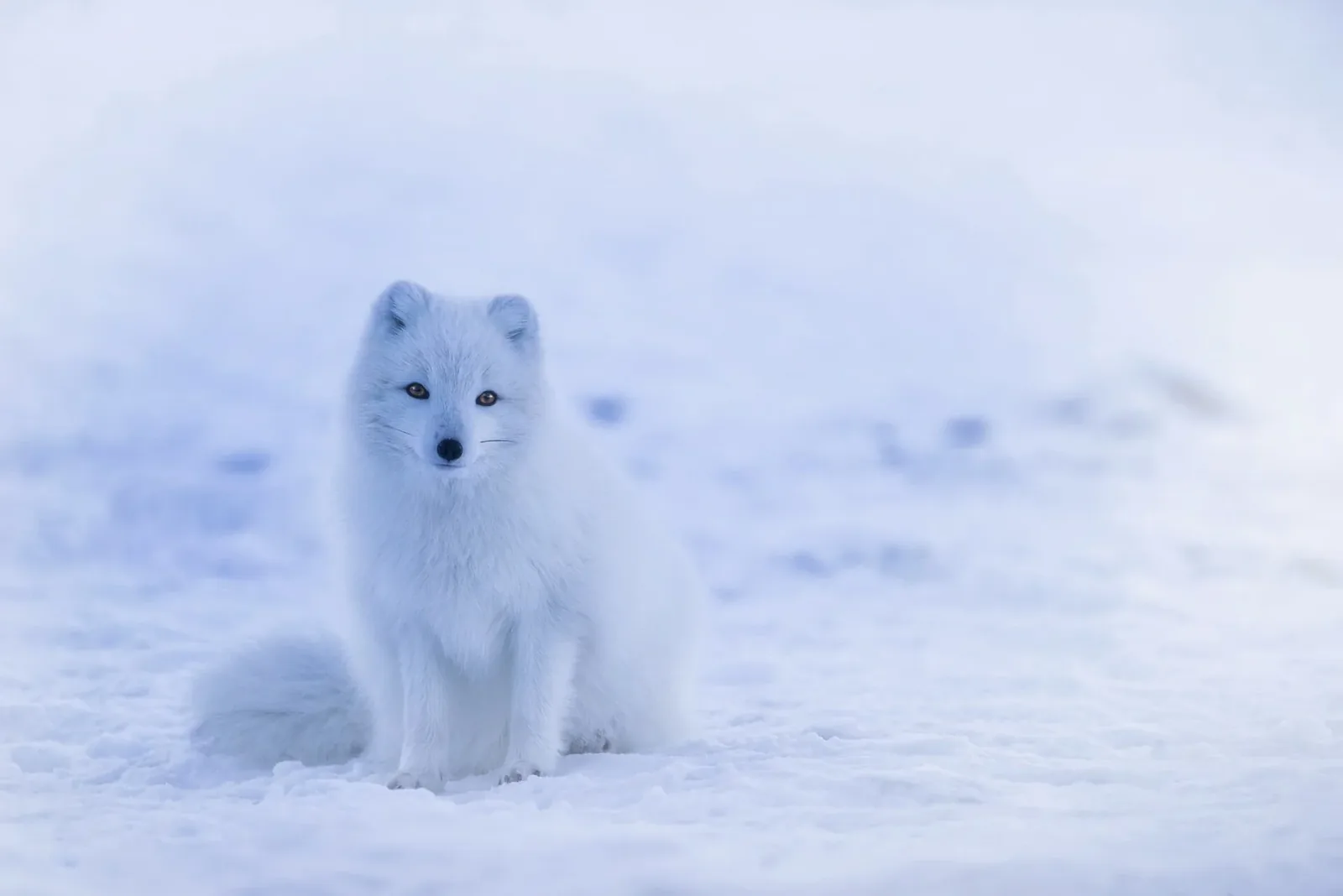
Seasonal coats help animals manage changing temperature, snow, and day length. Colour shifts can provide camouflage in some species, while insulation depends on fur structure and condition. The strategies differ among mammals and birds, and not every pale winter animal is responding to the same environmental cue.
Climate change can alter the timing or duration of snow cover, creating a mismatch between coat colour and background in some populations. The effect is species-specific and should be supported by field studies, not inferred from a portrait. This gallery uses original illustration to explain seasonal adaptations rather than documenting a particular wild individual.
A seasonal coat reflects more than color
Some mammals and birds change their plumage or fur as seasons shift. The change can affect insulation, camouflage, or both. Snowshoe hares and ptarmigan are well-known examples of animals that may become paler in winter, while other species grow denser coats without changing color. These strategies evolved in relation to seasonal conditions, but timing and appearance vary among species and populations. A portrait of an animal in winter should not be treated as proof of perfect adaptation: a mismatch between coat color and snow cover can occur when seasons change at different rates.
Insulation is a structure, not just a shade
A thicker winter coat traps air close to the body and can reduce heat loss. Feather layering and behavior such as huddling or choosing sheltered roosts also help birds conserve energy. The effectiveness of insulation depends on wind, moisture, body size, food availability, and activity. A white coat may provide camouflage, but its thermal properties are not identical for every species. National Park Service education resources describe several winter survival strategies, including coat growth and color change. Species-specific research is needed before assigning an exact thermal advantage to an individual animal.
Photoperiod and temperature can send different signals
Seasonal molts are often linked to day length and hormones, while temperature and snow conditions influence survival after the coat changes. If the timing of snow cover shifts faster than molt timing, an animal may be conspicuous against its background. This is one example of how climate change can affect a relationship between two seasonal processes. The risk varies with geography and species. Long-term observations of coat color, snow depth, and survival can test whether mismatches are becoming more frequent. A single photograph can illustrate a mismatch but cannot show how common it is.
Color change is not a universal winter rule
Many mammals keep a similar coat color year-round, and others use migration, hibernation, food storage, or behavioral changes to survive cold seasons. Even within a species, populations can differ in how much their coats change. Snow duration, habitat, genetics, and local climate all matter. It is therefore misleading to write that animals simply 'turn white in winter.' A field guide can identify a seasonal morph, but research is needed to understand how its prevalence varies. Readers gain a more accurate picture when a story places one adaptation among several strategies rather than treating it as the whole of winter ecology.
The coat is part of a wider food-and-cover system
Winter survival depends on access to food, shelter, and safe movement as well as insulation. Deep snow can make forage harder to reach or change predator movement, while sparse cover can increase exposure. The same conditions that make camouflage useful can also affect energy costs. Habitat fragmentation may make it harder to move between feeding areas. A seasonal coat story can therefore connect physiology with landscape ecology. Conservation plans that maintain winter range, escape cover, and movement routes may be as important as understanding the animal's fur or feathers.
Study coats without disturbing the animal
Researchers can document seasonal appearance through repeat photographs, museum collections, field observations, or camera traps. Identifying the same individual across seasons can be difficult, and light or camera settings may change the apparent color. A study should record date, location, weather, and method and avoid handling wildlife solely for a photograph. Opportunistic images can suggest a question, but standardized records are needed to test a trend. Sensitive species and den locations should not be exposed. Ethical observation protects animals and makes the resulting data more credible.
A changing winter needs dated evidence
Climate influences snowpack, temperature, and seasonal timing, but impacts differ among regions. The IPCC's assessments synthesize observed changes across species and ecosystems, while local studies can connect those changes to a particular population. A coat-color mismatch is a plausible mechanism, not a universal outcome. Reports should distinguish observations from predictions, identify the species and site, and state how often the mismatch was documented. Winter wildlife adaptations are remarkable because they link behavior, body structure, and habitat. Their future depends on how those elements change together, not on color alone.
Researchers can compare coat colour with snow cover and survival across seasons to test whether mismatch matters for a population. Results differ among species, and other factors such as predation, food, and body condition can affect survival at the same time.
Seasonal adaptation is a useful theme for observation, but a single image cannot show the timing or cost of a coat change. This illustration represents a broad ecological idea. Species-specific claims should be linked to field studies that identify the population and measurement used.